
While recovery efforts are ongoing, the likelihood of recovery currently appears low.

The EoI comes at a time when ISRO is working to enhance LVM3's payload capacity to five tonnes in GTO and is also evaluating the procurement of a Russian semi-cryogenic engine for the vehicle's second stage.

Indian-American scientist Amit Kshatriya's journey from watching rocket launches in Houston to becoming NASA's Associate Administrator is a testament to his dedication and expertise in space exploration.
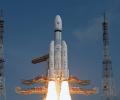
ISRO Chairman V Narayanan has emphasised the critical role of mission operations in ensuring the success of India's expanding space programme. He highlighted this at the Spacecraft Mission Operations conference, noting the importance of sustained teamwork and operational precision, particularly for long-duration missions like Chandrayaan-3 and the upcoming Gaganyaan programme.
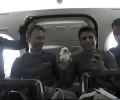
Shukla said the first few moments after they got shot into the vacuum did not feel that great, but soon it was "an amazing feeling".

Weighing 6,100 kg, the communication satellite would be the heaviest payload to be placed into the Low Earth Orbit (LEO) in LVM3 launch history from Indian soil.
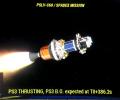
Dubbed as a prelude to ISRO setting up its own Space Station by 2035, the PSLV-C60 mission would also make India join an elite club in achieving this feat which is expected to take place in the coming days.
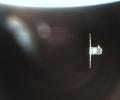
The Indian Space Research Organisation (ISRO) has successfully performed the docking of satellites as part of the Space Docking Experiment (SpaDeX). The docking was achieved after a series of maneuvers, including a trial attempt on January 12. The SpaDeX mission, launched on December 30, 2024, aims to demonstrate in-space docking technology using two small spacecraft. This technology is crucial for achieving complex mission objectives that require multiple rocket launches.
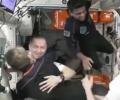
India's Group Captain Shubhanshu Shukla and three other astronauts on Thursday reached the International Space Station as the Dragon spacecraft docked with the orbital laboratory.

Nail-biting moments gave way to celebratory mood at the command centre of Indian Space Research Organisation in Bangalore on Wednesday, as its Mars Orbiter Mission or Mangalyaan entered the red planet's orbit.
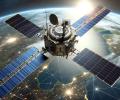
India is marching towards becoming the fourth country in the world to have space docking technology.
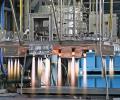
With these successful tests, ISRO has moved a step closer to India's first human spaceflight mission, Gaganyaan.
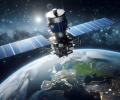
The private consortium would invest more than Rs 1,200 crore over the next five years to launch a constellation of 12 state-of-the-art Earth Observation satellites equipped with panchromatic, multispectral, hyperspectral, and microwave SAR (synthetic aperture radar) sensors.
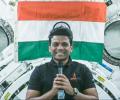
Group Captain Shubhanshu Shukla, the first Indian astronaut at the International Space Station (ISS), conducted a critical biomedical experiment aboard the ISS on flight day 6 of the Axiom 4 Mission, focusing on how microgravity contributes to muscle loss.

Narayanan has a long and distinguished career at ISRO, having played a key role in several important missions, including Chandrayaan-2 and 3, and the Gaganyaan programme.

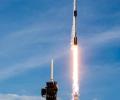
The mission was originally scheduled for lift-off on May 29 but was put off multiple times when engineers detected a liquid oxygen leak in the boosters of the Falcon-9 rocket and NASA also detected leaks in the ageing Russian module of the ISS.
'The solution is to replace, clean up, retest and proceed.' 'There is nothing to worry about if corrected.'
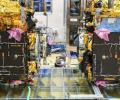
Demonstration of seed germination in outer space, a robotic arm to catch a tethered debris there, and testing of green propulsion systems are some of the experiments planned on the POEM-4 -- the fourth stage of ISRO's PSLV rocket that remains in orbit after launching a satellite.
.jpg)
India's maiden mission to Mars has traversed beyond the sphere of influence of Earth extending about 9,25,000 km in its 10-month long voyage to the red planet.
Solar Orbiter is on a unique trajectory that will allow its comprehensive set of instruments to provide humanity with the first-ever images of the Sun's poles, the US space agency said. This trajectory includes 22 close approaches to the Sun, bringing the spacecraft within the orbit of Mercury to study the Sun, and its influence on space, it said.

Indian Space Research Organisation's Mars Orbiter, which was placed in inter-Mars trajectory in the early hours on Sunday, has crossed Moon's orbit and is travelling beyond Earth's natural satellite.
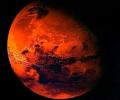
Crossing a major milestone in the country's space history, ISRO's Mars Orbiter mission ventured out of Earth's sphere of influence for the first time in an attempt to reach the red planet's orbit

The solar-powered spacecraft which left Earth five years ago finally reached its destination and entered into Jupiter's orbit.

ISRO chairman S Somanath said the success gave the space agency "greater confidence," as the GSLV will be next deployed in the NISAR mission, a collaborative effort with the US' NASA.

On Sunday morning, in its mission to place an earth observation satellite and students satellite into the low earth orbit, the SSLV-D1/EOS-02 blasted off precisely at 9.18 am amid cloudy skies from the first launch pad at Satish Dhawan Space Centre in this spaceport.

'Today onwards, the onboard thrusters will be fired and Chandryaan-3 will be taken away from Earth for an eventful landing on Moon's surface on August 23'

The successful launch of the maiden solar mission of the Indian Space Research Organisation came on the heels of the historic lunar landing mission - Chandrayaan-3.

Around 23 minutes after lift-off, the primary satellite got separated and it was followed by six other co-passenger satellites, which were deployed into the intended orbits sequentially, ISRO said.
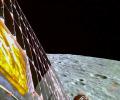
As scientists at the Indian Space Research Organisation (ISRO) gear up for the much-awaited soft landing of the Chandrayaan-3 spacecraft on the Moon's surface, the space agency may postpone the touchdown to August 27 in the event that health parameters of the lander module are found to be "abnormal", a senior official has said.

The ISRO on Sunday scripted yet another history after its LVM3 rocket successfully placed 36 satellites of United Kingdom-based OneWeb group company into intended orbits.

India's first unmanned spacecraft Chandrayaan-1 entered the lunar orbit on Saturday after Indian Space Research Organisation scientists successfully carried out a highly complex and tricky manoeuvre crossing another historic milestone in the country's space programme.

The entire mission operations of Chandrayaan-3, right from the launch till landing, "happened flawlessly" as per the timeline, the team that led India's third mission to the Moon said on Wednesday.

India will become the fourth country to master the technology of soft-landing on the lunar surface after the US, China and the erstwhile Soviet Union.

The Lagrange point 1 (L1) of the Sun-Earth system is about 1.5 million km from the Earth. It is about one per cent of the total distance between the Earth and the Sun.

The entire process being autonomous when the lander has to fire its engines at the right times and altitudes, use the right amount of fuel, and scan of the lunar surface for any obstacles or hills or craters before finally touching down.

This is the first mission by the Indian Speace Research Organisation this year.

Chandrayaan 3 follows the Chandrayaan 2 mission which did not achieve the desired soft landing on the surface of the moon in 2019, disappointing the scientists.
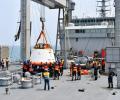
Nerves gave way to smiles at the spaceport in Sriharikota as delays and an anomaly-triggered 'hold' forced Indian Space Research Organisation (ISRO) scientists to revise the launch schedule of a test vehicle carrying payloads related to the country's ambitious human space flight mission, Gaganyaan which soared into skies after initial hiccups.

The mission objective is to ensure data continuity of ocean color and wind vector data to sustain the operational applications.

The Chandrayaan-2 spacecraft is expected to reach the moon's orbit on August 20 and land on lunar surface on September 7.
